Research By: Gouri Malik
In the world of investing, uncertainty is a constant companion. While investors aim for high returns, market volatility and unforeseen risks often lead to losses.
To mitigate this, many investors use a risk management strategy known as hedging. This guide will provide a thorough understanding of hedging, why it is crucial for any investor, and how it can be applied in real-world scenarios.
What is Hedging?
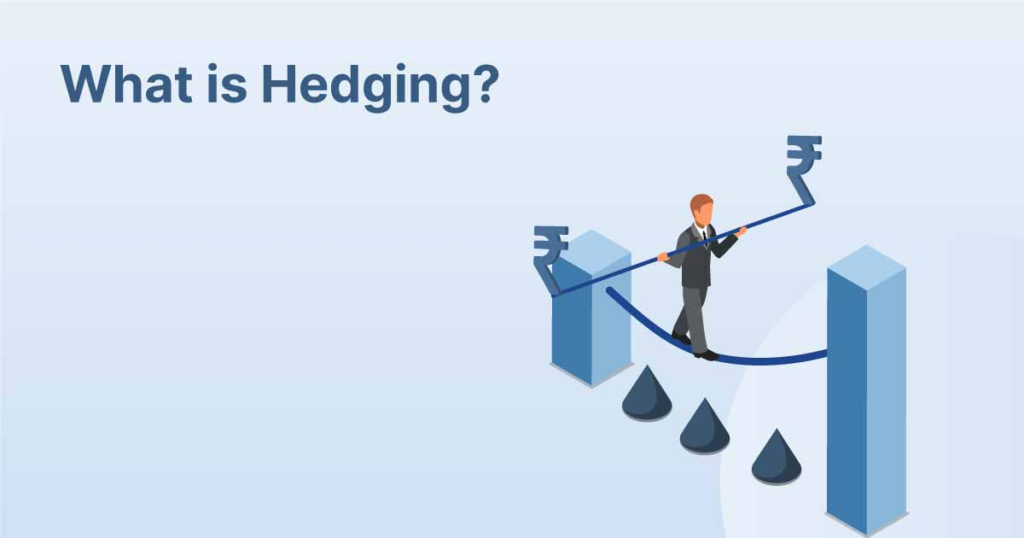
At its core, hedging is a strategy used by investors to protect themselves from negative market movements. Just like an insurance policy protects against unexpected events, hedging helps reduce the impact of adverse market fluctuations.
A hedge involves making an investment that will perform in the opposite direction of your primary asset or investment. If one investment loses value, the hedge offsets these losses by making gains, ultimately stabilizing the portfolio’s overall value.
Why Do Investors Hedge?
The primary reason for hedging is risk management.
Market risks such as currency fluctuations, interest rate changes, and commodity price swings can significantly impact investment portfolios. Investors, especially those with substantial holdings, use hedging to limit the downside impact of these unpredictable movements.
That said, it’s important to understand that hedging doesn’t eliminate risk entirely.
It is a trade-off where the potential profit may be capped.
However, for risk-averse investors, the focus is on preserving capital rather than seeking excessive gains.
Hedging Instruments and Strategies
There are several instruments and strategies used for hedging. Each varies in complexity, applicability, and the level of risk reduction they provide. Here are some of the most common ones:
1. Forward Contracts are custom contracts between two parties to buy or sell an asset at a predetermined price on a future date. Businesses often use forward contracts to hedge against currency or commodity price fluctuations. For example, a company expecting to receive payments in a foreign currency might lock in today’s exchange rate to protect against future declines in that currency.

2. Futures Contracts are standardized contracts traded on exchanges to buy or sell assets (commodities, currencies, indices) at a specific price on a future date. Investors hedge their exposure to asset prices. A farmer might use futures to lock in a selling price for crops, ensuring they avoid losses if prices fall at harvest.
3. Options are financial contracts that give the holder the right (but not the obligation) to buy (call option) or sell (put option) an asset at a predetermined price within a set time frame. Investors use put options to protect against a stock’s price drop. For instance, a shareholder buys put options to ensure they can sell at a fixed price, limiting losses if the stock declines.
4. Swaps are agreements between two parties to exchange cash flows or other financial assets, typically based on interest rates or currencies. Interest rate swaps help businesses hedge against rising interest rates. For example, a company with variable-rate debt may swap its interest payments for fixed-rate payments, protecting itself from rate hikes.
5. Commodities are physical goods like oil, gold, or agricultural products used as a base for financial contracts. Companies use commodity futures to lock in prices and hedge against rising costs. An airline, for example, may hedge against oil price spikes by locking in fuel prices with a futures contract.
To make this concept clearer,
Let's take a Real world example of a business using Hedging with Forward Contracts
For example,
Tata Consultancy Services (TCS) earns a significant portion of its revenue from clients based in the U.S. and Europe. Since its contracts with these clients are primarily in foreign currencies (like the U.S. Dollar, Euro, or British Pound), TCS is exposed to currency risk. Any adverse movement in exchange rates could lead to lower revenue in rupee terms, affecting profitability.
To mitigate this risk, TCS uses forward contracts to hedge against fluctuations in currency exchange rates.
How It Works:
TCS receives payments in U.S. Dollars for its services but incurs expenses primarily in Indian Rupees. If the U.S. Dollar weakens against the Indian Rupee, the company would receive less revenue in rupee terms when converting the dollars.
To protect itself, TCS enters into forward contracts with a bank or financial institution. A forward contract locks in an exchange rate for a specific date in the future. For example, TCS might enter a forward contract to sell U.S. Dollars and buy Indian Rupees at a rate of ₹80 per $1 for a settlement date six months in the future.
| Scenario 1 (Hedged Outcome) | Scenario 2 (Opportunity Cost) |
| If the rupee strengthens to ₹75 per $1 by the time TCS receives payment from its U.S. clients, the company will still be able to sell its U.S. Dollars at the predetermined rate of ₹80 per $1, avoiding a loss that would have occurred had they sold at the lower market rate of ₹75. | If the rupee weakens to ₹85 per $1, TCS will still have to sell the U.S. Dollars at ₹80 per $1 due to the forward contract. While this limits the upside gain, it provides certainty and stability for TCS’s cash flow. |
The use of forward contracts allows TCS to stabilize its revenue in rupee terms, regardless of how the exchange rate fluctuates during the contract period. By doing this, TCS can forecast its financial performance more accurately and avoid the risk of large currency-related losses.
Lastly, when should you Hedge?
Hedging is typically used in specific scenarios:
1. Portfolio Hedging: If you anticipate short-term volatility in the market but want to avoid liquidating your long-term positions, hedging can protect your holdings.
2. Foreign Investments: If your portfolio includes assets in foreign currencies, hedging can safeguard you from adverse currency fluctuations.
3. Interest Rate Risks: Investors or companies with significant exposure to fluctuating interest rates may hedge using swaps or bonds to stabilize cash flow.

