Research By: Navya Sinha
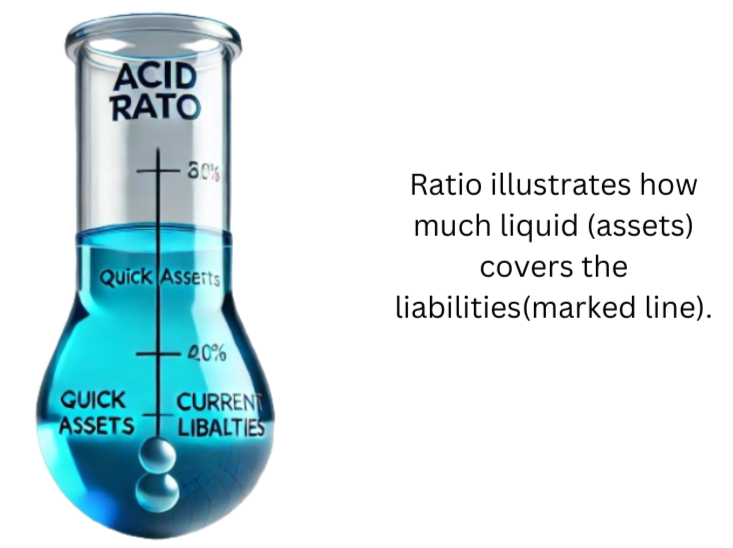
Acid-Test Ratio also known as the quick ratio, is a liquidity ratio that measures how sufficient a company’s short-term assets are to cover its current liabilities. In other words, the acid-test ratio is a measure of how well a company can satisfy its short-term (current) financial obligations.
Understanding The Ratio
Analysts sometimes prefer using the acid-test ratio instead of the current ratio (or working capital ratio) because the acid-test ratio excludes assets like inventory, which are difficult to liquidate quickly. This makes the acid-test ratio a more cautious measure of a company's financial health.
Generally, an acid-test ratio of 1.0 or more indicates a company can pay its short-term obligations. Companies with an acid-test ratio of less than 1.0 do not have enough liquid assets to pay their current liabilities and should be treated cautiously. If the acid-test ratio is much lower than the current ratio, a company's current assets are highly dependent on inventory.
However, this isn't always a negative indicator, as some business models naturally depend on inventory. For instance, companies having retail stores business might have very low acid-test ratios without being at risk. What's considered an acceptable acid-test ratio varies by industry.
For most industries, the acid-test ratio should exceed 1.0. On the other hand, a high ratio is not always good. It could indicate that cash has accumulated and is idle rather than being reinvested, returned to shareholders, or otherwise put to productive use.
The acceptable range for an acid-test ratio depends on the industry and marketplaces the company operates in, so comparisons are most meaningful when evaluating companies within the same industry.
Formula
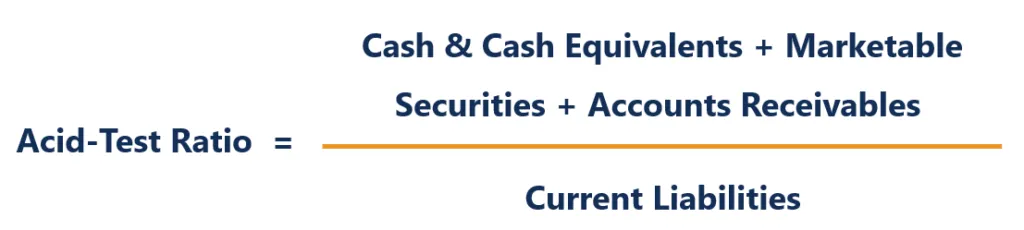
The following items can all be found on a company’s balance sheet:
- Cash and cash equivalents are the most liquid current assets on a company’s balance sheet, such as savings accounts, a term deposit with a maturity of fewer than 3 months, and T-bills.
- Marketable securities are liquid financial instruments that can be readily converted into cash.
- Accounts receivables are the money owed to the company from providing customers with goods and/or services.
- Current liabilities are debts or obligations due within one year.
The acid-test ratio formula can alternatively be rendered as follows:

where:
Current assets are assets that can be reasonably converted into cash within a year.
Inventories are the value of materials and goods held by a company with the intention of selling them to earn profits.
Interpretation
The acid-test ratio is used to indicate a company’s ability to pay off its current liabilities without relying on the sale of inventory or on obtaining additional financing. Inventory is not included in calculating the ratio, as it is not ordinarily an asset that can be easily and quickly converted into cash.
The higher the ratio, the better the company’s liquidity and overall financial health. A ratio of 2 implies that the company owns Rs.2 of liquid assets to cover each Re.1 of current liabilities.
Let's walk through an example using hypothetical data for a company, say Tata Motors.
Assuming the financial data for Tata Motors:
Current Assets = ₹17,000 crore
Inventory = ₹5,000 crore
Current Liabilities = ₹10,000 crore
Using the formula: Acid-Test Ratio = (Current Assets−Inventory) / Current Liabilities
= ( ₹17,000 crore - ₹5,000 crore ) / ₹10,000 crore
= 1.2
Tata Motors has an acid-test ratio of 1.2. This means the company has ₹1.2 in liquid assets for every ₹1 of current liabilities, indicating a relatively healthy liquidity position.
Difference between Quick Ratio and Current Ratio
Both the current ratio, also known as working capital ratio, and the quick ratio (acid-test ratio) measure a company's short-term ability to generate enough cash to pay off all debts should they become due at once. However, the acid-test ratio is considered more conservative than the current ratio because its calculation ignores items such as inventory, which may be difficult to liquidate quickly. Another key difference is that the acid-test ratio includes only assets that can be converted to cash within 90 days or less, while the current ratio includes those that can be converted to cash within one year.
Potential drawbacks and limitations of using Acid-Test Ratio as a measure of company’s liquidity position:
- To assess the company's liquidity status, the acid-test ratio is insufficient on its own. The acid-test ratio is frequently used in conjunction with other liquidity ratios, such as the current ratio or cash flow ratio, to provide a more thorough and precise assessment of a company's liquidity condition.
- Inventory is not included in the ratio's computation because it is not often regarded as a liquid asset. Nonetheless, some companies are able to sell their product fast and at a reasonable price. Under these circumstances, the company's inventory is considered an asset that is easily convertible into cash.
- The time and volume of cash flows, which are crucial elements in precisely assessing a company's capacity to pay its debts, are not disclosed by the ratio.
- The acid-test ratio assumes that accounts receivable are easily and readily available for collection, but that may not actually be the case.
- The acid-test ratio may not give a reliable picture of a firm's financial condition if the company has accounts receivable that take longer than usual to collect or current liabilities that are due but have no immediate payment needed.

